Sizing Systems vs Real Fit: What Matters in Boots

Boot Size Systems Can Be Confusing
US vs UK vs EU Shoe Sizes
(Same foot. Three systems. Too much confidence.)
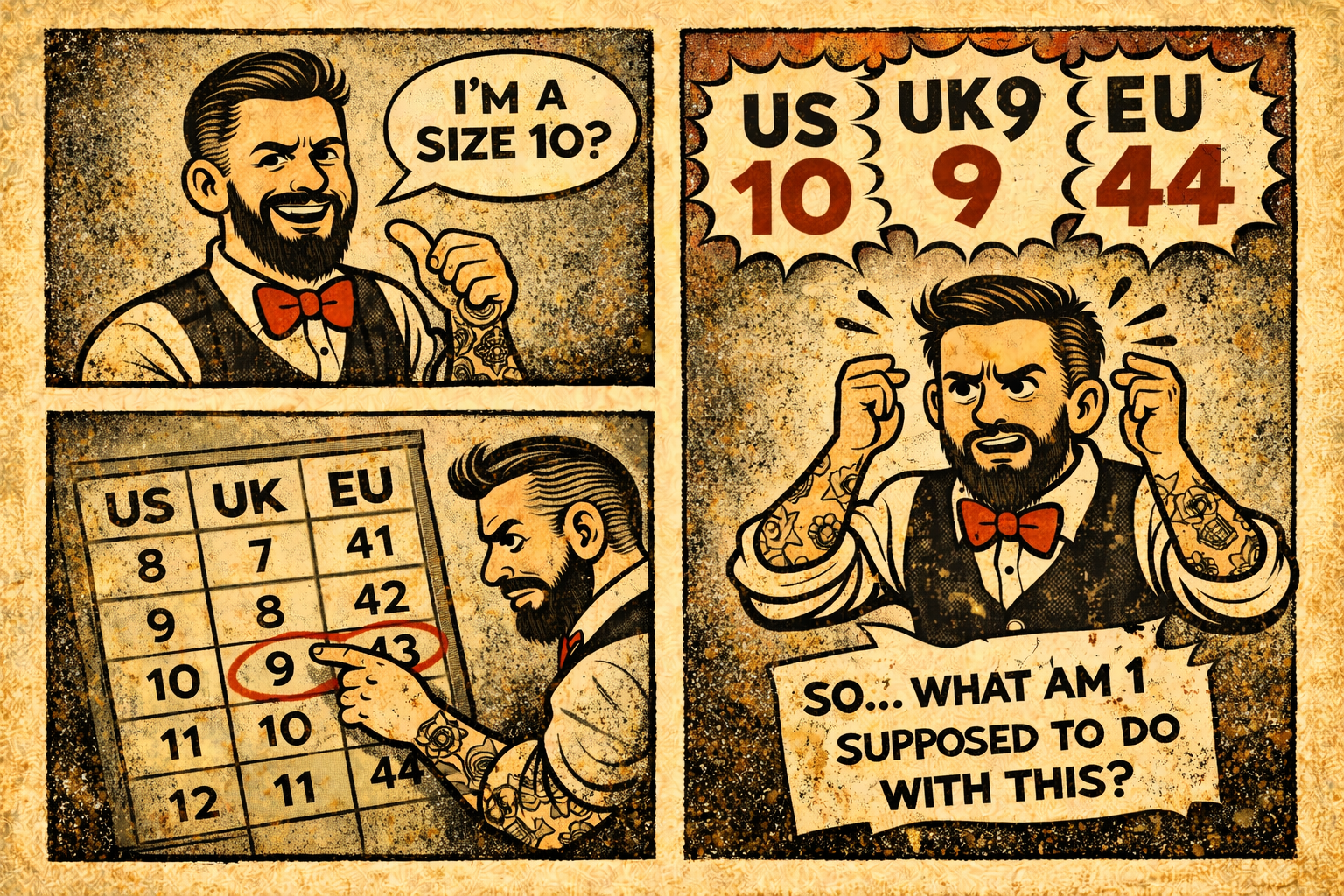
If you’ve ever bought boots from overseas and thought, “How can I be a 10 here, a 9 there, and a 44 somewhere else?”, welcome to the problem.
Shoe sizing isn’t universal. It’s three major systems (US, UK, EU), plus brand-specific quirks stacked on top. So when someone says “I’m a size 10,” what they really mean is: “I’m a 10 in the one brand I’ve been buying since 2008.”
This post breaks down what each system is, how they differ, where they’re used, how width works in each, and how to convert between them without treating a chart like it’s scripture.
Why sizing systems don’t match
Here’s the core issue: none of these systems are a direct measurement of your foot in a single unit (like inches or centimeters).
They’re sizing standards that developed in different places, at different times, based on different reference methods. Then brands interpret those standards through their lasts, the 3D shapes boots are built on.
So “conversion” isn’t math. It’s translation.
The three main sizing systems (and where they show up)
1: US Sizing
Where it’s used:
The United States, and a lot of global brands that sell heavily into the US market.
What it looks like:
Men’s sizes: 7–13 (common), half sizes are normal.
Women’s sizes: a different scale (not the same number as men’s).
Why it’s useful:
US sizing is the most common “language” in online boot buying, especially for heritage, work, and moto boot customers.
The catch:
US sizing isn’t a clean physical measurement. A US 10 in one brand can feel like a 9.5 or 10.5 in another depending on last shape, toe box volume, and how the brand grades sizes.
Naang Boots uses US sizing.
It’s the clearest reference point for most of our customers, and it maps cleanly to how boot people talk about fit. It’s by no means perfect, but it gives us a great starting point.
Width (US): the letter codes
The US system is one of the most common places you’ll see official width letters on the shelf, especially in work boots, heritage boots, and some athletic shoes.
Typical men’s widths:
B / C = narrow
D = standard
E / EE = wide
EEE / EEEE = extra wide (less common, but it exists)
Women’s widths vary by brand, but you’ll commonly see:
A = narrow
B = standard
C / D = wide
How it works (the part people miss):
Width letters are supposed to scale with length. A “D” on a US 8 isn’t the same physical width as a “D” on a US 12.
But the exact millimeters behind “D” or “EE” are not perfectly standardized across brands.
Some brands change patterns significantly between widths. Others make a mild tweak and call it “wide.”
Real-world takeaway:
US width letters are useful, but they’re not a guarantee. A “D” in one brand can feel like an “E” in another depending on the last.
2: UK sizing
Where it’s used:
The UK and many Commonwealth markets. Also common in heritage footwear brands with British roots.
What it looks like:
UK sizes typically run about one number lower than US men’s.
Why it’s different:
UK sizing evolved from British conventions and doesn’t line up cleanly with US numbering.
The catch:
Same issue as US: it’s still filtered through the brand’s last. Some UK heritage makers run narrow, some run generous, and they all claim they’re “true to size.” Sure.
Width (UK): letters exist, but you’ll see different conventions
UK sizing can include widths, but it’s less consistently presented unless you’re shopping certain makers (especially dress and heritage brands).
You may see:
Letter widths (same general idea as US, but not always the same mapping)
Or brand-specific width codes (some use F / G / H as “standard to wide” in certain UK/EU contexts)
How it works:
UK widths still depend heavily on the brand’s last library.
Some brands are disciplined about width grading.
Others offer “wide fit” as a general category without clear measurement meaning.
Real-world takeaway:
UK width systems exist, but you need the brand’s definition. Don’t assume UK “G” equals US “EE” without checking.
3: EU Sizing
Where it’s used:
Most of Europe
and often used as the “default international” size label on product pages.
What it looks like:
EU sizes like 41, 42, 43, 44, 45, 46.
Why people trust it (sometimes too much):
EU sizing looks more systematic because it’s a steady numeric scale.
The catch:
EU sizing can be consistent-ish for length, but it still doesn’t tell you width
Width (EU): less common on the label, but there are systems
EU sizing is mostly treated as “length-first,” and width is often handled by:
different lasts within the brand (instead of printed width letters), or
specific width schemes used by certain manufacturers.
You might see:
W / Wide (simple category labels)
Numeric width codes (often brand-specific)
Or, in comfort/dress contexts, letters like F / G / H (depends on the maker and market)
How it works:
EU brands often solve width by offering multiple lasts (standard last vs wide last), rather than printing something like “D/E/EE.”
That means the width may be real, but it’s “hidden” inside the model/last name instead of obvious on the size label.
Real-world takeaway:
With EU sizing, you usually have to read the product line/last info to understand width. The number alone doesn’t tell you enough.
The Universal Truth About Width Systems
Even when a system “accounts for width,” width is still only one slice of fit.
Two boots can be the same length and width on paper and still fit totally different because of:
instep volume (how tall your foot sits)
heel pocket shape
toe box height and taper
arch position (heel-to-ball alignment)
Width codes help. Last shape decides.
At the end of the day, the last your boot is built on determines more about the fit than length and width ever could.
The real reason you can’t trust conversions blindly
A conversion chart assumes boots are all built the same. They’re not.
Fit is controlled by:
Last shape: toe box width/height, taper, heel pocket, instep height
Construction: welted builds, insoles, shanks, lining thickness
Materials: thick leather breaks in differently than thin leather
Intent: dress last vs work last vs hiking last vs moto-focused boot
So yes, use a conversion chart. Just don’t treat it like a blood oath.
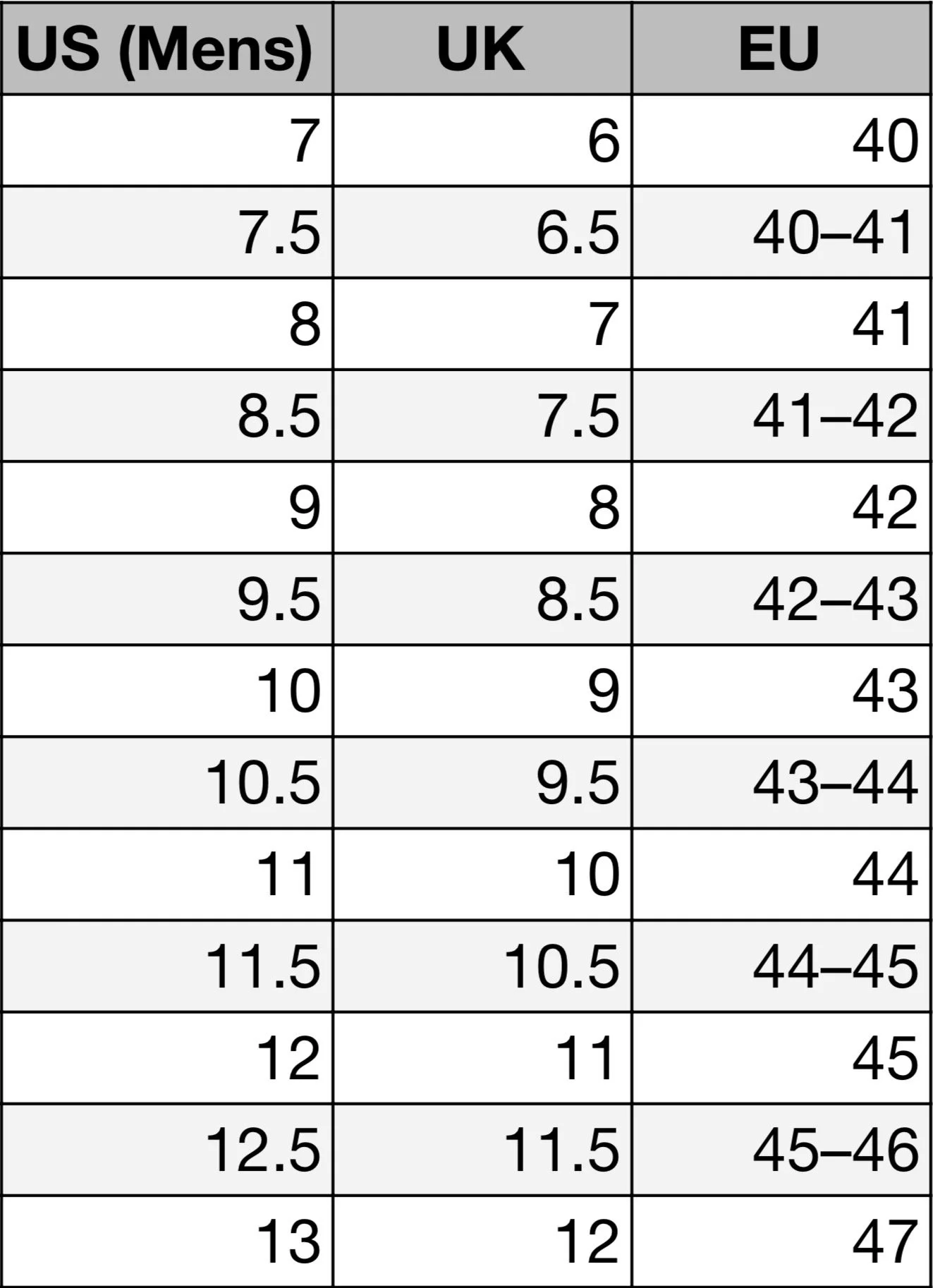
How to Use a Boot Size Conversion Chart
US ↔ UK ↔ EU conversion table (men’s)
This is the most common conversion mapping used in boot/shoe retail. It gets you close. Then you use fit notes and common sense.
Boot Size Conversion Chart
Fast rule of thumb (men’s):
US ≈ UK + 1
EU is best handled by the chart (because there is no quick and easy conversion)
A quick note on women’s sizing (because this is where people get wrecked)
Women’s sizing isn’t just men’s sizing with a different label.
A common approximation is:
US Women ≈ US Men + 1.5
Example:
US Men 9 ≈ US Women 10.5
From there you convert into UK/EU.
But again: brand variance is real, and even more so when it comes to women’s sizing.
The “between sizes” problem
If you’re between sizes on a chart, don’t panic, just don’t guess randomly.
A few sane rules:
If you’ll wear thick socks, lean up.
If the boot has a low volume last, lean up.
If you like a snug performance fit, lean down (carefully).
If you need toe room for walking, travel, or riding, lean up. don’t size down and call it “break-in.”
Break-in should soften a boot.
It should not negotiate basic geometry.
Where Naang fits into this
We use US sizing because it’s the most practical common language for our customers.
But we don’t design boots around a number. We design them around foot shape, wide toe boxes, a natural last, and support that works when you’re actually moving through the world.
So use the chart, get your baseline, and then think about how you live in your boots:
long days walking Bangkok sidewalks
riding all day, feet on pegs
travel, concrete, heat, swelling
real use, not just standing still in a mirror
If you want help picking a Naang size, send us your Brannock readings (heel-to-toe, heel-to-ball, width) and we will work with you to get the perfect fit without the usual online ordering roulette.