What The Hell Is a Brannock Device?
What Exactly Is a Brannock Device? (And Why It Still Doesn’t Guarantee Fit)
Most people don’t know their real size.
They think they do. They’ve been buying “a 10” since high school, so they’re a 10 forever, right?Meanwhile every brand fits different, your feet change over time, and boots aren’t sneakers.
-
What’s going on, everyone? It’s Dana from Naang Boots. Today, I want to talk to you about the Brannock device. This is the industry standard for measuring your foot size, and it’s something that we highly recommend using before you order a pair of our boots.
Now, most people think they know their shoe size, but they’re often surprised when they actually get measured on a Brannock. There are three key measurements that the Brannock device takes.
First is the heel-to-toe length. This is what most people think of as their 'size.' You place your heel against the back cup and look at where your longest toe lands on the scale.
The second measurement, which is arguably even more important for a good fit, is the heel-to-ball length, also known as the arch length. This is measured using the sliding pointer on the side of the device. You want to align that pointer with the ball joint of your foot—that’s the widest part where your big toe joint is. This measurement tells us where the flex point of the boot should be. If the boot doesn’t flex where your foot flexes, you’re going to have a bad time.
The third measurement is the width. Once you have your foot positioned, you slide the width bar over to the side of your foot. This gives you a letter grade, from AAA all the way up to EEE.
When you’re measuring, it’s important to do it while standing up, because your foot naturally spreads out under your body weight. You also want to make sure you’re wearing the type of socks you plan on wearing with your boots.
Once you have these three numbers—your heel-to-toe, your heel-to-ball, and your width—you can use our size chart to find your perfect fit in Naang boots. Usually, if your heel-to-toe and heel-to-ball sizes are different, we recommend going with the larger of the two to ensure that the flex point aligns correctly.
Getting a correct measurement on a Brannock device is the best way to ensure that your new boots feel great from day one. If you don’t have access to one, a lot of local shoe stores will have them and are usually happy to let you use it.
Thanks for watching, and as always, if you have any questions, just let us know!
Enter the Brannock device: that metal contraption in shoe stores that looks like it was invented the same decade as the jukebox. It’s old-school, not sexy, and still one of the best first steps you can take toward getting boots that actually fit.
But it’s not magic. It’s a measuring tool. A good one. With limits.
Let’s get clear on what it is, what it measures, and why it can still leave you with a boot that feels “fine in the store” and awful by kilometer five.
So what is it?
A Brannock device is a mechanical foot measurer used in shoe stores for decades. It’s usually metal, usually scuffed, and usually more accurate than “I’m usually a…”
It’s built around a few simple parts:
A heel cup (locks your heel into a consistent starting point)
A sliding length bar (reads your foot length)
A width bar (reads forefoot width in letters)
No batteries. No apps. No hype. Just repeatable measurement.
How to use a Brannock Device - What it measures (the stuff that matters)
Here’s what a Brannock is actually reading when someone slides those pieces around your foot.
1) Heel-to-toe length
This is the one everyone expects: heel to longest toe. That gives you the “number size” most people identify with (US 9, 10, 11, etc.).
Simple. Useful. Not the whole story.
2) Heel-to-ball length (arch length)
This is the sleeper stat. The one that explains why you can have “roomy toes” and still feel like the boot is wrong.
Your ball of foot (that big joint behind your toes) needs to line up with the boot’s flex point. If it doesn’t, you get:
pressure in the wrong place
creasing in weird places
“why does this feel tight even though my toes have space?”
Here’s the punchline:
Your toes can say “10” while your arch says “11.”
Ignore the arch number and you’re basically gambling.
3) Forefoot width
This is the letter—A, B, D, E, EE, etc.—measured across the widest part of your forefoot.
A lot of people are wearing the wrong width and just blaming “break-in.” Which is a nice story we tell ourselves while our feet file a complaint.
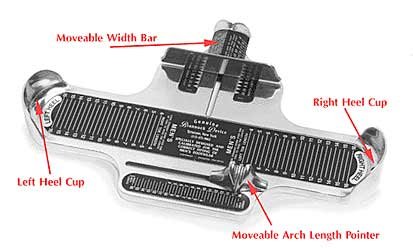
Parts of the Brannock Device
What it doesn’t measure (and why you still get burned)
A Brannock is a great start, but it’s not a full blueprint of your foot. It does not reliably capture:
Instep volume (how tall your foot is)
Heel width (narrow heels + wide forefoot is common)
Toe splay (your toes spreading under load)
Foot shape (tapered vs square vs “my pinky toe needs civil rights”)
Swelling over the day
How you actually move (pressure points, gait, etc.)
So yes, you can be “measured right” and still end up in boots that don’t work. That’s not a you problem. That’s the tool’s limits.
How to use a Brannock without screwing it up
If you want the measurement to mean something, do it like this:
Measure both feet. Fit the larger foot. Always.
Stand up. Weight on the foot. Sitting lies.
Measure later in the day. Morning feet are optimistic. Afternoon feet are honest.
Don’t ignore arch length. If heel-to-ball reads longer than heel-to-toe, pay attention.
Wear the socks you’ll wear with the boots. Don’t measure barefoot then act surprised.
Why Brannock size doesn’t equal “boot size”
Here’s the part brands love to skip.
A Brannock gives you measurements. Boots are made on lasts—3D shapes that decide toe room, instep height, heel shape, and how the whole thing wraps your foot.
Two boots can both be “size 10” and fit like:
one was built for an accountant
the other was built for a guy hiking out of a canyon at dusk
And even within “boots,” construction changes how they feel:
toe box height and shape
leather thickness and break-in behavior
insole thickness
shank stiffness and support
welted construction vs glued, etc.
Brannock is a starting point. Not a guarantee.
The wide toe box problem (aka: “my size is what I can tolerate”)
If you’ve spent years in narrow toe boxes, your “normal size” might not be your size. It might be the size you’ve been cramming into because that’s what stores carry and what looks “sharp.”
A Brannock can tell you length and width, but it won’t tell you what happens when your toes spread naturally under load—walking, riding, standing all day, living in your boots instead of posing in them.
At Naang, we respect measurement. But we build around foot shape—because that’s what your body is actually doing down there.
What to do next
If you want to translate a Brannock reading into real boot fit, get these three numbers:
Heel-to-toe length
Heel-to-ball length
Width letter
Then match that to the brand’s last and fit notes—not just the number on the box.
If you want help, send:
those three measurements
what socks you’ll wear
whether you like snug or roomy
…and we’ll point you at a sane starting size.
Because guessing is expensive. And your feet have better things to do than “break in” a bad fit.
Here’s a closing paragraph that keeps it Naang—confident, not salesy, and it ties the whole thing back to why shape matters:
At the end of the day, the Brannock device gives you numbers—but boots are built around shape. That’s the gap most brands never talk about. You can measure “correctly” and still end up in a boot that pinches, crowds your toes, or forces your foot into someone else’s idea of what a foot should look like. Our take is simple: start with measurement, then respect the foot. Build a boot around the way humans actually stand, walk, ride, and live—not just what looks good on a shelf. That’s the whole point of a Naang last.
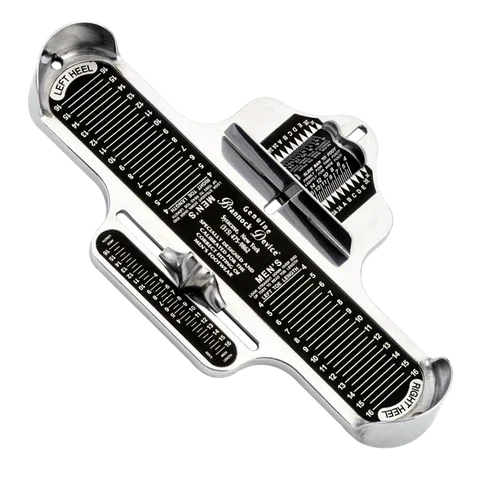
Brannock Device For Boot Sizing